



SESSION OVERVIEW
In July 2026, King’s College London Students’ Union convened the inaugural UK–Canada Students’ Union Leadership and Partnership Development Conference. It brought together elected student leaders, Chief Executives, General Managers and professional staff from students’ unions across both countries.
The conference tested a central proposition: could students’ unions operating within different national systems create a form of international collaboration that was reciprocal, practical and capable of strengthening participating organisations and improving outcomes for students?
Designed differently from a conventional conference, the programme combined three days of experiential learning across five UK students’ unions with two days of independently facilitated reflection and co-design. Participants experienced organisations and their practices in context before considering their shared challenges, complementary strengths and the practical value of longer-term collaboration.
This session will share the development journey, programme design and principal learning from that work. It will explore why similarity and difference both create value; why international learning should involve adaptation rather than adoption; and how collaboration could support leadership development, organisational learning, benchmarking and improved practice.
The session will also consider the emerging idea of an international learning alliance: a wider community of independent students’ unions connected by shared purpose, within which interested organisations could collaborate around particular themes or challenges.
The work remains at an early stage. The session will therefore distinguish between a credible proof of concept, early evidence of value and the longer-term impact that must still be demonstrated. Attendees will be invited to consider what their own organisations could contribute to and gain from a reciprocal international learning community
Session Outcomes:
Attendees will:
- Understand how the UK–Canada programme progressed from an initial idea, through reciprocal learning and research, to a tested proof of concept.
- Explore a two-part model combining experiential learning with structured reflection and collaborative design.
- Consider why international learning is most valuable when organisations adapt ideas to their own context rather than simply adopt another organisation’s model.
- Identify how international collaboration could create value for individuals, participating organisations and the wider students’ union movement.
- Examine the potential for a flexible learning alliance, including smaller coalitions formed around shared themes, projects or challenges.
- Consider how the value of international collaboration should be assessed through leadership, organisational practice and student benefit rather than meetings, travel or visibility alone.
PRESENTER
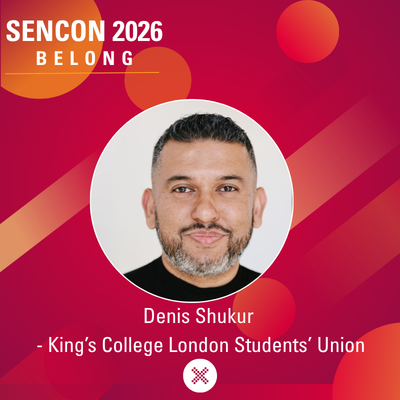
Denis Shukur is Chief Executive of King’s College London Students’ Union (KCLSU), one of the UK’s oldest and most diverse students’ unions, representing a global community of around 40,000 students.
With nearly two decades of experience across students’ unions, universities and membership organisations, Denis has led complex, member-led organisations through growth, change and transformation. His leadership spans strategy, governance, financial sustainability, organisational development and the creation of purposeful partnerships between students, students’ unions and universities.
Denis began his career in market research, shaping his commitment to using evidence and student insight to turn voice into influence and measurable change. He believes leadership is ultimately about people: creating the conditions in which they can succeed, bringing them together around a shared purpose and translating ambitious ideas into practical action.
In 2026, Denis worked with students’ union leaders from the United Kingdom and Canada to develop the inaugural UK–Canada Students’ Union Leadership and Partnership Development Programme. Convened by KCLSU and delivered with partner students’ unions across London and Manchester, the programme brought together elected student leaders, Chief Executives, General Managers and professional staff. It combined experiential learning, structured reflection and the collaborative design of a longer-term international partnership.
Denis’s subsequent work set out a wider vision for reciprocal international collaboration, one that values different systems equally, favours adaptation over imitation, and measures success through stronger leadership, organisational practice, belonging and outcomes for students. It is guided by a simple principle: partnership is not the outcome; it is the mechanism for creating lasting change for the communities we serve.